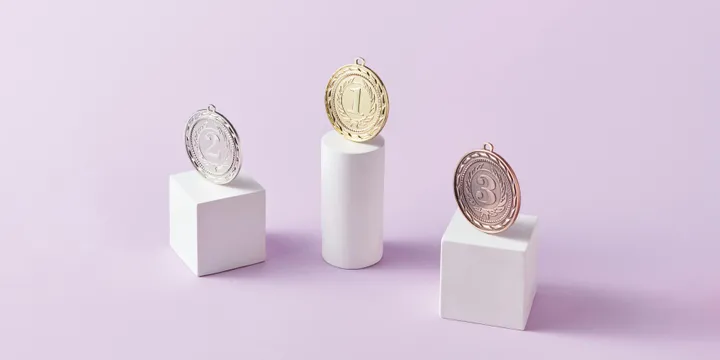
Right before my senior year of college I was randomly selected to receive a privately sponsored scholarship from a generous donor family. Part of the process was an interview with a representative of the family, along with an administrator from the university’s English department. The family representative (an older man with a gruff presence) got straight to the point: “now, we usually give these scholarships to students with more financial need than you.” I nodded—I was aware that, because I was still listed as “dependent” on tax forms, I lived in the not-so-sweet spot of the tax bracket spectrum. (That is, not low enough to qualify for financial aid, but not high enough to be able to actually afford anything.) He continued, “and looking at your transcripts… you’ve done well in your classes, but you’re no star.”
The faculty member seated next to him blushed hard and his eyes grew massive. He looked like he was stifling a laugh of incredulity and discomfort as his gaze bore into the table between them and me. I channeled my own stunned laughter into a wide grin as I said “well, you’re not wrong.”
I couldn’t even be offended—the man paid for half of my last semester of college, and for that I was grateful. I was more taken aback by the candor, which again, I couldn’t argue with. I had worked hard, performed decently (I thought), averaging a B+ across the board . . . but he was right: I was no star. Nothing to merit any spotlight.
A comment as comically offhand as that was easy to laugh about but, admittedly, the truth poked holes in my confidence, prodding deep-seated insecurities to the surface—that I am profoundly average, that my contributions may be negligible. That I don’t make enough of an impact to be remembered, or considered valuable. That I may not be worth noticing.
I told that story to friends and family because, of course, I thought it was hilarious in a kind of “can you believe this? How amazing?!” way, but also because I figured the more I joked about the comment, the lighter it would become. The laughter of my audience confirmed that they agreed, how amazing, I can’t believe he would say that, but each made sure to adamantly reassure me “you are totally a star.” Some would then contribute their own stories of shocking, moderately abrasive comments they’d received, or backhanded compliments they too couldn’t help but laugh at. “That’s my new favorite compliment,” I’d say.
We laugh so we don’t cry, I’d think.
And maybe that’s what planted the idea in me, to ask people what their favorite compliments actually were. Maybe hearing people’s worst compliments had me thinking about their best. I don’t know what inspiration or insight I thought I would hear in those answers, but curiosity and the need for some buoyancy urged me to ask anyway. I texted family, posted on an Instagram story, brought it up with friends in person:
What words do you hold onto? What stands out? What means the most to you?
“What is one of your favorite compliments you’ve ever received?”
I got dozens of responses, some delivered with quiet emotion and others with beaming smiles. Answers varied, from:
You radiate happy.
You’re like a walking hug.
You’re refreshing to be around.
to compliments like:
No one does empathy like you do. You’re so good at it and everyone should have a friend like that.
I love your smile. (Whenever someone says this, I’d like to feel like it’s a time when I was being kind.)
You’re genuine, and that is hard to find in people.
Moms answered:
I love that every time I see one of your kids they have a big smile on their face.
You are exactly like your mom.
My daughter told me “you are the most interesting person I know.”
and siblings answered:
I was telling someone how wonderful my brother was and they said “you’re describing yourself!”
My twin sister tells me “you’re a force to be reckoned with!”
and individuals with careers in teaching, therapy and social work added:
You’re the teacher I’d pick for my kids if I could.
I believe the good things you say to me.
You insist on seeing the good in people.
I added each to a list on the note app in my phone. And then school and work and life got in the way of my contemplating, and my project was shelved before I could really look at what the words we hold onto might say.
That list sat on my phone for a couple years. And then recently I read a tweet, that was quoted in a book, which was recommended by a new friend, who was introduced to me by a good friend, which is how I think revelation often arrives—through a chain of average things. The tweet said “PAY ATTENTION TO THE THINGS YOU PAY ATTENTION TO.” This is one of those statements that immediately feels big, even if you aren’t entirely sure what it means yet; maybe it feels that way because of its brevity and simplicity, combined with its parallel structure of wording. Or because the word “ATTENTION” calls our attention innately. Regardless, it made me think of that list I had stored away on my phone, of words that people had paid extra attention to. And it was the lens I needed to ask “why?”
Why would that feel good, to be told your smile is genuine? Or you are just like a parent or sibling? Or you embody grace or elegance or sunshine? Why is that what they paid attention to, and hold onto now?
Why do those things matter?
When I asked “what is a favorite compliment you’ve gotten?” the words sounded easy, like asking “Where was your favorite vacation?” or “Tell me about the best dinner you’ve ever had.” I figured it was a simple question with simple answers. But when I considered the “attention” behind each of their answers I realized that my question wasn’t really about compliments at all… the question wasn’t “who are you?” or even “what is something people say about you?”, which could have invited those generalized, one-dimensional responses.
What I was really asking was: “who do you hope you are?”
At the root of every favorite compliment is some quality that the receiver finds valuable, something they want to be because of the impact it has. I’m reminded of Charlie Mackesy’s The Boy, the Mole, the Fox, and the Horse, in which the Mole asks the Boy, “what do you want to be when you grow up?” and the Boy responds, “Kind.” Mackesy’s Boy voices what we (perhaps unconsciously) hope for— to be, of all the things we could achieve, good.
A compliment holds a microcosm of our valued “good,” which is, I believe, why we pay attention to them. When one person is told “you insist on seeing the good in people” what they hear is “you are someone people can trust to be compassionate, to forgive, to love despite flaws.” When another is told “you make people happier just by being around you” they hear “you provide the kind of positive energy and uplifting impact that people want, that people need.” and when another is told “I can tell you care” they hear “I can feel that you’re a safe place, that you won’t judge me, I can feel that you want what is best for me, I can feel you want me to be well.”
We hope that we are those things. We want those statements to be true. Because if they are, that means we are doing at least one thing right.
Here is one of my favorite compliments I’ve ever received: I have a sweet, wonderful, perfect little sister named Lucy who, despite our thirteen-year age gap, is my best friend. When she was five years old (and I nineteen), she went running into my parents’ bathroom one Sunday morning all dressed for church and exclaimed “Mom! I look pretty like Rachel!” I was already moved out of the house by this point, so I was not around to feed ideas like this into her little mind, which tells me the thought was all her own. No obligation to boost an ego, no expectation of reward or return; to her the statement was just the truth.
It’s been seven years since she said that, and I still think of it when I’m feeling particularly unattractive, un-star-like, or generally mediocre; when I am extra self-conscious about being single, or extra unimpressed with what I’ve accomplished so far as an adult. Any number of intrusive thoughts, really. I hold onto that thing Lucy believed was true, not because I want to be “pretty” in the traditional sense of the word, but because at the root of that compliment is the idea that I might be someone she thinks of when she is feeling confident and beautiful. At the root of that compliment, I’m told I may be someone worth thinking of as bright, or encouraging, someone that makes people feel their best. That is valuable to me. I hope I am that.
There’s a line in a book that I love where the protagonist notices something that would normally be insignificant and says “it’s not a big thing, but I guess it’s true—big things are often just small things that are noticed.”
And I think that’s what makes the difference, the noticing. Each favorite compliment was of a small thing—an unassuming behavior, a quiet kind of good—that when noticed, paid attention to, became big enough to provide the needed reassurance that they are not average, or negligible, they do make an impact, they do matter, they are doing something right.
A better writer may be able to give the perfect metaphor here, make a more profound statement to send the reader weeping in joy to the rest of their day, invigorated by the thoughts of good words doing good things for people just wanting to be good; a smarter person would know just what to say about the implications of paying attention to these things we pay attention to, of recognizing what we hope we are and why. But I’m no star… and that’s fine with me. My sister says I may be someone worth thinking of as bright, and that is enough.